

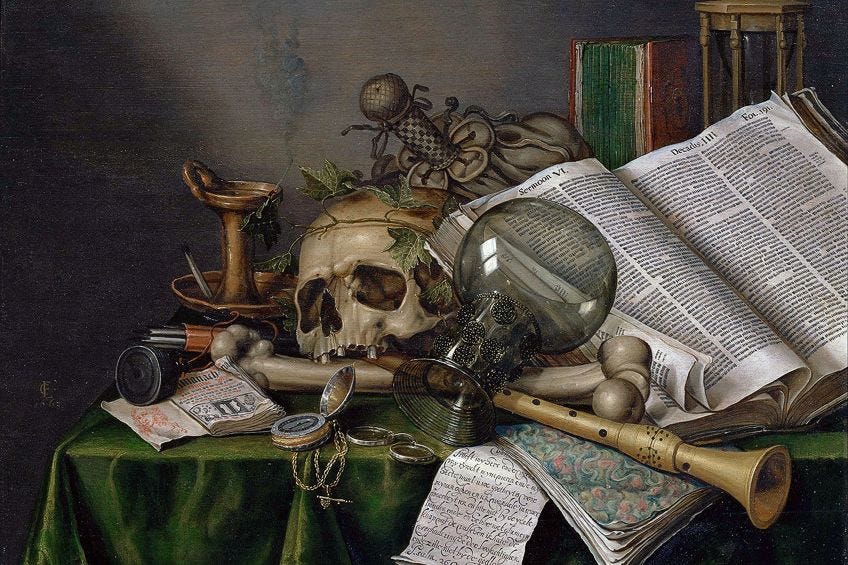
childhood
Five years old and on my deathbed. Or at least, that’s what it felt like.
My earliest memories from my childhood were being terrified of death. I’d lie in bed, desperately trying to fall asleep, but unable to as anxiety attacks overcame me. To escape, I’d pace around the house for hours, punching myself in the leg over and over, trying to swap the pain in my head for something else.
In the morning, I’d wake up groggy, sometimes with bloodshot eyes, and always with a softball-sized bruise hidden underneath my shorts. I’m sure my parents were confused why their elementary schooler looked like he needed a morning coffee. I was always too afraid to tell them the truth.
Third grade was the first time I had an anxiety attack at school. We were learning about the solar system. Somewhere in that lesson, it finally clicked for me. The universe was so, so big. And our planet was just this small dot inside this infinite void. I was just this insignificant kid on this insignificant rock. I meant nothing, my life meant nothing, a nd my death would mean nothing. I threw up in the bathroom at lunch.
During the last week of elementary school, I wasn’t so fortunate. I broke down in class, crying. I was inconsolable, sputtering gibberish. My teacher had 25 other 10-year-olds to wrangle; it was time for her to do damage control. This would be my first time meeting with the school counselor.
I sat in the counselor’s chair as she lobbed over question after question. I desperately wanted her help. But for some reason, my lips betrayed me. I didn’t know how to verbalize how I felt. I wasn’t sure if this fear made me a nutjob. I was scared this episode would make its way back to my parents. I felt that if I opened my mouth, the cat would finally be out of the bag. The whole world would finally know that I had this freakish phobia. I would forever be an ‘other’.
So I stayed quiet. She poked and prodded, trying her best to make headway. After a few minutes, she took a big sigh. We sat there in silence for a few minutes, her analog clock ticking loudly in the background. She gave me one of those half-raised eyebrow looks. It was like she was sizing me up, searching for some thread that she could pull on. But we were at an impasse, and if I didn’t want to save myself, how the hell was she going to save me? “Okay, Vedant, let’s walk you back to class.”
As a kid, I had always told myself that when I was an adult, I would finally go to therapy, and it would solve all my problems. I’m not sure where I specifically got this impression 1. Whatever the case, I always promised myself that when I had my own money, I would deal with and pay for it myself. I would never let my parents in on my troubles. Instead, my secret would be kept safe in solitude. What a terrible burden for a child to carry on his own.
and still…
As I got older, I learned to manage these death-induced anxiety attacks better. They happened less often, probably a dozen times in the next 10 years, but when they broke through, they were worse than ever (an episode each year, what is this, the Thanatophobic Super Bowl?)
There was a night my sophomore year when I got too high and tried to walk home. My chiefers out there know that if you have anxiety issues, smoking makes it 10x worse!
An anxiety attack rolled over me, this time so bad that I sat on a bench at the corner of Rio Grande and 22nd Street for hours, crying, failing to calm myself down.
My episode during junior year was even worse. This time, the pain wouldn’t go away, and none of my usual distractions were working. I was so desperate to make the pain stop that I could have done anything. Part of me was concerned that ‘anything’ could have meant self-harm… we lived on the 7th floor, with a balcony peering into the courtyard.
There was a weird cacophony of feelings in my head: my fear of death, anxiety, fight or flight, and the urge to do something rash. It wasn’t a good recipe. I was too afraid of what would happen.
Ironically, my cripplingly fear of death would keep me from doing anything too stupid. The rational part of my brain knew I would be okay. Still, I was scared about what lengths I would go to, and I didn’t want to risk being alone. It was now 4 AM on Tuesday. I began banging on my roommate’s door, and with enough persistence, they eventually woke up. They calmed me down, and I eventually slept on the couch. I had an 8 AM midterm a few hours later.
…still nothing
To this day, I still haven’t gone to therapy for my fear of death. I know that it won’t be a silver bullet, but I know that I still should. There is some invisible wall, something between my fear and shame that holds me back.
I’ve also had fewer anxiety attacks as I’ve grown older. Part of the reason that these attacks don’t happen anymore is that I don’t let them. I don’t dwell on death. At the first sight of any destructive thoughts, I’m quick to change the subject in my head. I refuse to watch horror movies. And if I’m consuming any other media that reminds me of death, I stop it immediately. Lastly, life has become a lot busier. I don’t have the idle time to ponder these things as I once did.
I’m not proud of this. It feels like instead of confronting my fear, I sulk in the shadows and sneak by. I have not conquered the problem. But I’ve gotten damn good at hiding from it. I know that this is a losing strategy. I will have to answer to death. What I do now, and my relationship death while I still have the blessing of life, will decide if, in the waning moment of my life, I cower in the face of death, or if I will stand proudly in its midst.
elegance of the hedgehog (or, new perspectives)
A chapter I recently read in The Elegance of the Hedgehog has emboldened me to take death head-on.
There’s a scene where Paloma (a tweenage girl) and her family visit her grandmother in a retirement home. Her family goes through the motions: polite small talk, dusting the shelves, oogling at the ‘oh so beautiful’ marble countertops. But everyone’s on edge. Everyone is too afraid to be honest, to say what they’re thinking. Grandma is nearly dead.
So instead, they treat her mind like papier-mache. They’re too afraid to be honest with Grandma or discuss anything important. They don’t care to know how she’s actually feeling, because she might as well be dead anyway.
However, Paloma is different.
She sees her grandmother, really sees her. She talks to her like a human. She listens to her stories and laughs with her. And when she leaves, unlike the rest of her family, she ruminates on her visit. She doesn’t pretend like grandma is fine. She is dying, and this fact deserves to be on the front stage. To Paloma, the cowardly thing to do is to ignore and move on.
This scenario happens all the time in real life.
When the young people see signs of aging in their elders, they hastily look in the other direction. Young people are invincible. The problems with aging are so distant, so foreign, that frankly, they’re not worth worrying about.
But even if we’d like not to admit it, we do worry. We worry because we know that soon, we will be sitting in that wheelchair. We will look down at our fingers and be surprised to see the wrinkles and cracks. We will try to summon our strength as we walk up the stairs, but we will find that it is zapped. Our liveliness now gone, our horsepower fading.
So when we see these old people, we are actually terrified. We weep because we love them and we don’t know what they will be, if at all, when we see them next.
But mostly we weep for ourselves. We see ourselves in them, and it terrifies us. Death is the one thing we can’t control. It is also the one thing that is inevitable.
Just like Paloma, I think that we should not move on from mortality so easily. We should not forget the old people, or that we are inexorably aging. We should sear it into our minds.
How does old age look?
How does it smell?
How do old people eat?
How do they move, so slowly and gently, with their hands shaking uncontrollably?
What do they talk about?
What do they remember?
How do they feel?
We should use this remembrance to live life vicariously. We should live every day knowing that we will die. We will die, we will die, we will die.
So how do we do that?
countdown
Firstly, I think we should be frequently practicing rituals that discuss death. Religion seems to be well-suited for this. In my view, religious doctrines have two primary objectives:
Explain the unexplainable phenomenon of death
Give us moral frameworks to maximize our time alive and create meaning for our death.
But religion isn’t the only tool to address these objectives. Even for agnostics like myself, there are ‘scientific’ practices we can rely on.
For example, every day, I remind myself that I will die. I keep a daily log of how many days I have until death. I assume a lifespan of 80 years.2
Seeing this number (20,795 and dwindling!) brings me clarity. Every day, it provides an opportunity to evaluate whether my actions are serving my goals, and if my goals are serving my purpose. Often, as I stare at the number, I think of the Steve Jobs quote:
“For the past 33 years, I have looked in the mirror every morning and asked myself: 'If today were the last day of my life, would I want to do what I am about to do today?' And whenever the answer has been 'No' for too many days in a row, I know I need to change something.”
It also makes me more effective. Staring in the face of death, timewasters like Reels seem trivial rather than tempting. I want to squeeze the juice out of every second of life. I want each droplet to practice my craft(s), build excellent health, spend time with my loved ones, and enjoy my hobbies. Death is great at narrowing the cone of focus towards the things that matter. I’m sure this is the same power that religion brings to people.
I’m unsure about the confounding variables here, but since I’ve started this practice, I’ve cherished moments more. It’s a short hop from ‘you only live once’ to ‘every moment only happens once’. I find that I am more optimistic, more engaged in conversations, and more grounded in the present.
discourse
I’ve now 180’d my perspective to believing that death should not be taboo. No more secrets about our existential dread. No more hushed tones when we discuss loved ones dying. The more that we build up mysticism around death, the harder it is to rationalize it. Instead, if death were more matter-of-fact, then folks could more readily share their beliefs. We could build shared frameworks on how to consider death. This would make it easier for each individual to cope with this burden.
This is likely true for all vices/addictions/fears; open and honest discourse would facilitate a society better equipped to address these problems. But death would benefit the most: by nature, it is the most unexplainable and existential problem humans face.
For example, what if when a child started kindergarten, their parents and teachers began discussing death with them? What if this were part of the curriculum?
In American society, it is taboo to talk to kids about their mortality. So when kids cross the street, parents tell them to be careful and look both ways. They don’t tell them, “If you get hit by a Honda Civic, you’ll almost certainly die.” Instead, it’s for some abstract reason called ‘safety’.
It should not be the job of an authority figure to carry the burden of mortality for their dependents. Instead, it should be their job to safely transfer this knowledge as quickly as possible. We are all after animals, with evolutionary instincts to survive and reproduce.
Not talking about death does not mean that kids don’t think about it. It means that they’ll have to decipher and digest it on their own. And I hope that my experiences prove that the downsides of this approach are dramatic. As early as kids can carry on a coherent conversation, death should be a talking point. Kids should have avenues to talk to their teachers, parents, and most importantly, their peers about death.
Again, maybe here is where religion shines, and the stories shared in sermons and youth groups strengthen your sense of mortality over time. Perhaps some other households discuss death and aging more openly. But my upbringing had none of these qualities. I was on my own.
I hope that by the time every kid comes of age, they’ll be equipped to handle their mortality. Yes, the process will be gradual and sometimes frightening. But it will be worth it.
The puberty/sex talk is a canonical moment in every American teen’s life, and for good reason, too. We don’t want unplanned pregnancies or widespread STDs. Death is an even more important topic. Why should it not be treated in the same manner?
funerals
Funerals are a great way to capture the zeitgeist of death in a given culture.
Some funerals are parties. Some are religious gatherings, filled with chanting and prayers. However, Christian Anglo-Saxon, and broadly, American funerals are depressing. Black tie. Quiet voices. And if it’s depicted in a movie, there’s often a healthy dose of pattering rain.
They don’t have to be this bleak! Other cultures show us that this is possible. Yes, we should mourn the deceased’s life. We should remember their accomplishments and how they impacted their loved ones’ lives. But what if we re-framed it and used it as an opportunity to reflect on the lives that those in the audience still have to live?
Just like the ‘days till I die’ log, what if a funeral, instead of a chance to mourn what was lost, is a chance to celebrate what we have, and what is still left to be had!
I don’t think that this is something that can systematically be changed. I would never suggest to grieving people what they should be doing for the funerals they put on.
All I know is that for my funeral, I hope that people use it mainly as an opportunity to practice the joy of life, not the sadness of death.
the octagon
I want to put more aside time to think about death. I want to put myself and grapple with. I guess you could characterize it as some form of meditation.
I want to explore deeply where it hurts, where in the past I would be quick to change the subject. Why am I so scared of death? What do I think will happen when I die? And if there is no afterlife, why is that such a bad thing?
I want to put myself in a position to die gracefully. This does not mean how I die, but how I accept this death. It would be a shame to go out crying and screaming; it’d be a sign that I’m weak, unready, and unwilling.
My goal is to die like they said Buddha did, at peace and with a slight smile all the way to the end.
That probably won’t be enough, though. I need to go to therapy. I know that this is not an uncommon fear. There are probably tried and true frameworks to diagnose and cope with this dread.
Whatever the tactics, the idea is directionally consistent: the only way that I will defeat this fear is by facing it head-on. It will be painful to do so. I will be scared and frankly. I’ll probably have to go through another anxiety attack or two. The path of least resistance tells me not to, but eventually I will pay for this shortcut, and that’s a price that I don’t want to pay.
dying, dying, dead
I can tell you all of this. I can tell you how I’m dealing with death, how I think we should live, and how we should change a handful of things about society to deal with death.
I can tell you all that and still admit that I’m terrified of death. I don’t want to die. I hope that I never die. I hope that ASI can develop the sorcerer’s stone so that I can live forever. Even still, immortality is definitionally impossible. No matter what I do, how hard I think, or how much I squirm, I know there will be an end for me.
Maybe it boils down to my mindset. Maybe I should find a way not only to come to peace with death, but look forward to the day I die of old age with my old ones surrounding me. Maybe I should believe that if I live my life morally, I'll achieve salvation, or that I'll be reborn as one of those particularly tall trees!
I so badly want it to be true. I so badly want there to be something to look forward to. But honestly, fuck that. I can't get myself to believe. I think that the most likely outcome is a cold, decomposing body. I’ve seen it in humans, I’ve seen it in animals. I can’t shake the feeling that the same will happen to me.
Maybe my soul will go somewhere sweeter. Or maybe, my ‘soul’ is just a collection of neurons firing, ones that will cease to fire after my heart stops supplying blood to my brain. Tragic.
I’ll be honest. I don’t think I’ll ever get over this fear. I’m sure that I’ll get better coping mechanisms and structures like my ‘days to death log’. I’m sure that friends and family will now be more inclined to discuss death with me, and from those conversations, something productive will come out of it.
But in the end, I will have to walk to the plank into the void by myself. No sword, no shield. Just me, bare and naked. I wonder, when I get to the end of the plank, and I’m looking down into nothingness, what will my last thought be? Will I be afraid? Will I be solemn? Will I be accepting?
It won’t matter what I think. I’ll still have to jump.
My guess is that Hollywood writers are more likely to be neurotic than the average person, so they write about these themes more.
This is a conservative measurement to create urgency and focus. My goal is to live to see 2100 (98 years old), but I am hopeful that with technology and my focus on health, living into my 120s will be difficult but attainable.
Proud of you for writing this one
great read; very vulnerable piece and interesting framing of death as a vice — all vices that have the power to suffocate have equal ability to liberate when you dig and understand the fight deep enough