

Thinking that stems from the ‘Lump of Labor’ Fallacy is widely used by opponents of AI, Robotics. Let’s explore what it means and why these people are wrong.
The core thesis of this fallacy is that the economy is a fixed pie. When you replace a job (say, with automation), these jobs do not get replaced in the aggregate.
This is why, in the face of increasing automation in both the physical and digital worlds, they are skeptical about the job market for future generations. These opponents are causing us to decelerate the adoption of AI and Robotics, costing the world trillions of dollars of productivity.
What happens during major technological shifts?
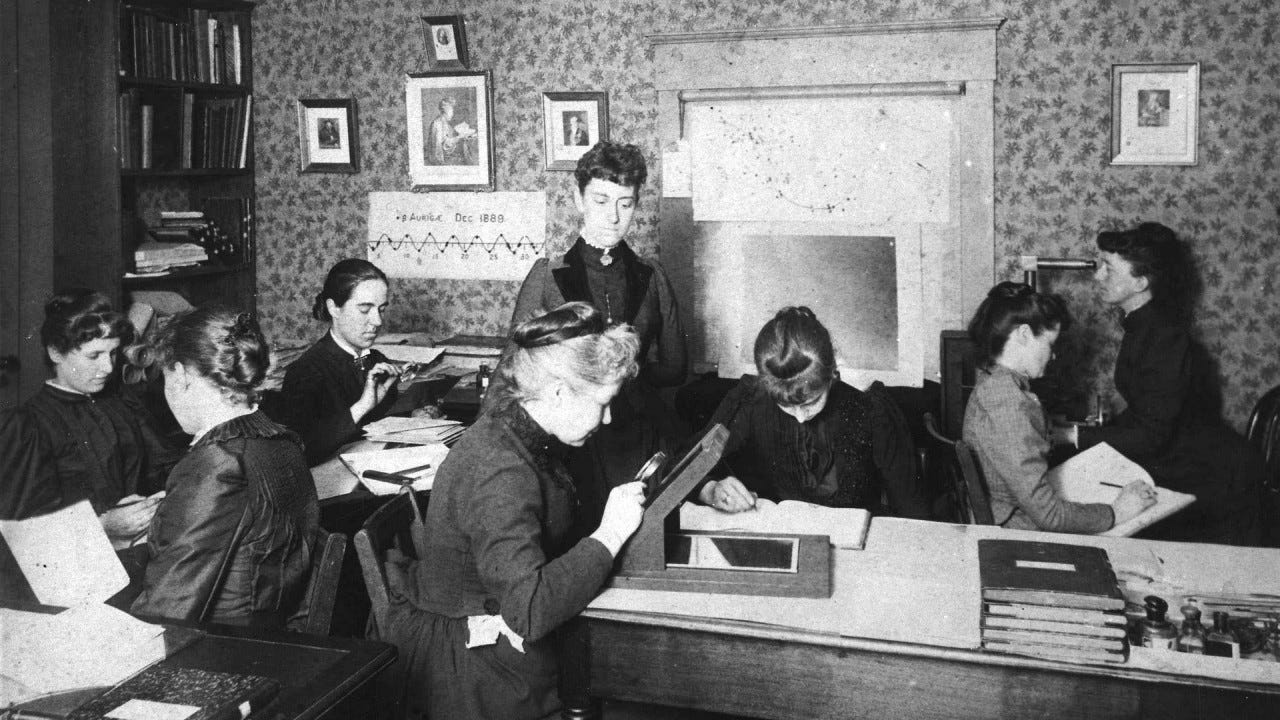
Historically, the 'Lump of Labor' has been proven wrong time and time again. The Industrial Revolution replaced artisans with more factory workers who could make goods cheaper and faster. The IT revolution replaced human computers (Gen Z doesn’t realize this is where the word ‘computer’ comes from) with millions of engineers and IT workers. AI and Robotics will have the same effect.
Usually, new technological advancements can, in the short term, replace jobs. That much is true. But technological advancements also catalyze economic growth and, in the aggregate, create far more economic opportunity than the status quo.
Technology leads to the cost of goods falling and the quantity of goods increasing. This creates more prosperity as people can consume more and live better lives. This is a virtuous cycle because the job market benefits from increased productivity and consumption.
Where do the jobs go?
It's unclear where the jobs will be replaced in AI and Robotics. There are leading theories -- teleoperators for robots, more customer service reps in food and hospitality, many more artists, and my favorite, 1000x job creation in the space industry. Still, nothing is certain, and this is not inherently a bad thing.
Since AI is humanity’s most significant technological leap to date, it’s unclear and, therefore, easy to default to the pessimism that there will be no jobs left.
However, when Henry Ford made the first Model T, it was equally unclear that, one day, there would be millions of taxi, truck, and rickshaw drivers around the world. It would have been unclear that people would unlock the ability to earn more by working outside their one-mile radius. It would have been unclear that a multi-trillion-dollar logistics industry was waiting to be created.
People have the right to be somewhat cautious about Robotics and AI. It’s a huge, huge, huge leap. Entire labor markets will shift. Our cost structures will radically transform. In the physical world, the cost of goods will asymptote to the cost of raw materials. In the digital world, the cost of goods and services can feasibly asymptote to 0.
Cheaper goods = more opportunity
What would the economy look like with exponentially cheaper goods and services? I'm not sure, but here are some questions that excite me about the future of the job market.
What if the cost of education approached 0? How would the world benefit from a billion kids who finally have the opportunity to be engineers, scientists, and surgeons thanks to the power of a world-class, truly personalized education at their fingertips?
What if the cost of healthcare, in everything but drugs/surgery (which robotics will make cheaper), approached 0? What would the world do with billions of healthier, more productive people with longer lives?
What if the cost of software approached 0? What could an individual accomplish if they had the power of a 500-person software team at their fingertips? (And what would happen to Miru’s biz model 😅!?)
In this world where cheap goods are proliferated, consumption increases, and the job market will flourish.
The ripples
We can’t leave people behind. Jobs will undoubtedly become automated, and more emphasis should be placed on re-education and transition paths to new, more economically productive opportunities.
I'll be the first to say that these efforts need more work, and I'd be happy to help anyone with an idea.
Inequality will probably increase in the short term as people with capital and knowledge use AI to increase their leverage. Still, in 20-30 years, inequality will be much lower than it is today. How the world weathers the turbulence between those times is yet to be seen.
Again, it's okay to be cautious. As much as I would like the world to be a techno-utopia, the real world doesn't conform to those ideals. Real people will be affected during this transition and must be cared for.
But there is a distinction between being cautious and being a Luddite. Progress is good. Creative destruction is good.
The opponents are wrong. It's a great time to be an optimist. AI and Robotics will bring increased prosperity to the world.